Daily note, Tuesday 3rd November 2026
WTI: Qeshm bounce, prompt spread doesn't follow
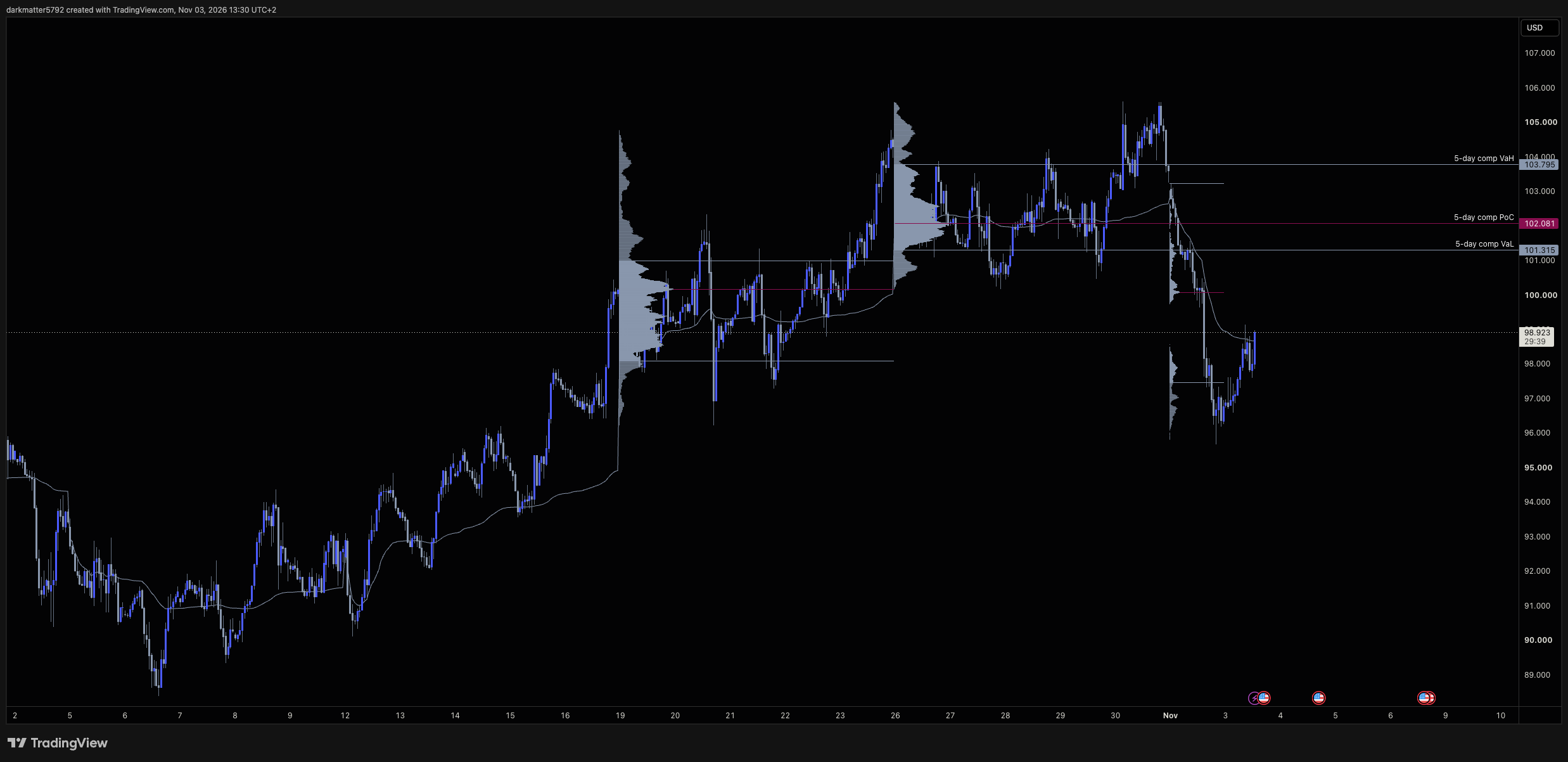
US strikes on Qeshm Island put $2 back on flat price overnight. WTI Dec/Jan narrowed on the bounce, and diesel did the lifting: futures diesel cracks rose about 6%. WTI is back at the VWAP in Monday's low-volume gap. Short below the $100.1 dPoC.
- Crude oil
-
WTI crude USOUSD
Bearish below $100.1
Low$95.7dVaL$97.5dPoC$100.1VaL$101.3PoC$102.1dVaH$103.2VaH$103.8$98.9
Buy zone Sell zone Price at 11:30 GMT. dVaH, dPoC, dVaL: this week's developing 5-day composite (from Monday 2nd November). VaL, PoC, VaH: last week's 5-day composite (26th–30th October). Low: Monday's flush low.
Cracks, spreads, flows
Qeshm put some of the premium back. Not much. US forces struck Iranian targets on Qeshm Island, at the mouth of Hormuz, on Monday night. US officials called it defensive, aimed at stopping attacks on shipping. The WSJ reports it was one of a series of limited strikes. No oil infrastructure was hit and Iran hasn't retaliated so far. Qatar still says an interim deal is possible. WTI is about $2 above Monday's close. That's a bounce of less than a third of Monday's drop.
The prompt spread didn't confirm it. WTI Dec/Jan is slightly narrower on the bounce than at Monday's settlement. Flat price is up and the front spread is softer. Jan/Mar did widen, by about a tenth, so the risk is going into the deferred spread, not the prompt barrel. Brent Jan/Mar firmed a little. Cushing is 27.0M bbl, 9.3% over the 5-year average. Nothing in the hub needs prompt WTI bid.
Diesel did the lifting. Futures diesel cracks are up about 6% on Monday's settlement, gasoline cracks a little less. The latest EIA spot data, for 27th October, has the Gulf Coast diesel crack at $96.8 and the 3-2-1 at $50.2. Distillate stocks are 102.8M bbl, 9.6% under the 5-year average, and every strike headline lands on the tightest leg first. That's refinery crude demand holding up.
The Brent–WTI Jan futures spread narrowed again. WTI bounced harder than Brent. The arb is still open: exports were 4.85M b/d in the week to 23rd October.
Shipping is still getting hit. UKMTO counted 30 attacks on commercial vessels in October, a record. One more vessel was hit off Oman on Sunday, and an Indian crew member was killed off Oman. Barrels are still moving round the strait. The Qatar framework is Iran stopping attacks in Hormuz in return for the US lifting its blockade on Iranian ports.
Options made Monday's drop faster. Monday's drop ran straight through heavy December options open interest. Dealers short puts sell futures to hedge as price falls, and that adds to the selling. Part of Monday's speed was hedging, not news. The same flow works in reverse on a bounce, which is why the overnight spike came so fast and stalled.
The Gulf is shipping. Gulf Arab crude exports rose about 10% in October to just over 15M b/d, roughly pre-war rates, on Bloomberg tanker tracking. Iran's exports are still effectively halted. Dubai's prompt spread has slipped into contango (Bloomberg), a sign of surplus in the East. Physical has been loose for weeks. Futures are only now catching up.
Diesel is the tight product into winter. Spare refining capacity sits mostly in China, which still caps product exports. US distillate stocks are 9.6% under the 5-year average. That's why diesel cracks lead every strike headline, and why refinery crude demand holds even as the war premium bleeds.
Funds have little to sell. Managed money was net long 31,128 WTI contracts on 27th October, 24% of the 3-year range. (Charts.)
The read: a strike on election eve bought $2 of flat price and a softer prompt spread. The market doesn't believe Qeshm is the escalation. Rallies into the developing dPoC are for selling while the prompt spread fades. The risk is what comes after the polls close. Netanyahu is reportedly pushing for strikes after the vote. A hit on oil infrastructure or a Hormuz closure puts the premium straight back.
The auction
Monday broke out of last week's balance. Last week's 5-day composite built value at $101.3–103.8, with the PoC at $102.1. Monday opened under the VaL and never got back in. This week's developing composite, which starts Monday, has two distributions with a thin middle: value $97.5–103.2, dPoC $100.1, and a low-volume gap from about $98.5 to $99.8 where the 13:30 GMT flush went through. The flush low was about $95.7.
Since then: higher lows from $96.3, and the Qeshm headline lifted price back into the gap. At 11:30 GMT WTI is $98.9, sitting on the VWAP. This morning's high is about $99.2.
Low-volume gaps don't hold price. Either the bounce runs through to the $100.1 dPoC and gets sold there, or it fails at the VWAP and goes back to the $97.5 dVaL. Acceptance above $100.1 opens the $101.3 composite VaL.
WTI levels and setups
Short below $100.1. Sell the dPoC rejection at $99.8–100.2. Targets $97.5, then $95.7. Stop $101.4, back in last week's value.
Sell setup dPoC rejection
- Sell zone
- $99.8 – $100.2 Top of Monday's low-volume gap, into the dPoC
- Stop-loss
- $101.4 Back inside last week's composite value
- Targets
- $97.5 / $95.7 Developing dVaL, then Monday's flush low
Invalidation: Hourly acceptance above $100.1 puts the upper half of the developing composite back in play, with last week's $101.3 VaL next. Above $101.3 price is back in last week's value and the short is off. A confirmed escalation after the polls close does the same.
| Level | What it is | Role today |
|---|---|---|
| $103.8 | Last week's 5-day composite VaH | Top of last week's value |
| $103.2 | Developing dVaH (this week) | Resistance |
| $102.1 | Last week's 5-day composite PoC | Resistance |
| $101.3 | Last week's 5-day composite VaL | Stop side; back in value above it |
| $100.1 | Developing dPoC (this week) | Pivot; sell zone |
| $98.9 | VWAP | Price is here |
| $97.5 | Developing dVaL (this week) | First target |
| $95.7 | Monday's flush low | Second target |
Today's calendar (London time)
- Tuesday: US midterm elections. The first polls close at 23:00 GMT, the first big batch at 00:00.
- Tuesday 21:30: API weekly crude stocks
- Wednesday 15:30: EIA Weekly Petroleum Status Report. Watch the SPR line and Cushing.
Cracks and Dated Brent–WTI are calculated from EIA daily spot prices against WTI Cushing (latest published: Tuesday 27th October). Timespreads are described from futures settlements, not quoted. Prices are taken from a CFD feed (USOUSD) and can differ from futures prices and from your broker's quotes.